The University of British Columbia (UBC) is embarking on a unique, biomass-fuelled heat and power system, the first of its kind in North America. The UBC Bioenergy Research and Demonstration Project will enable UBC to produce clean, renewable biomass-based heat and power for its campus. The project involves collaboration between Vancouver-based Nexterra Systems Corp., GE Jenbacher (General Electric’s gas engine division), FPInnovations and The University of British Columbia.
The UBC bioenergy project has two main operating modes. The first mode – commercial thermal (heat) mode – will utilize commercial Nexterra gasification technology to convert waste wood into a clean synthesis gas, or “syngas” that will replace some of the natural gas currently used for campus heating. The second mode – the demonstration (heat and power) mode – will use Nexterra proprietary syngas conditioning technology with a high-efficiency GE Jenbacher gas engine to convert syngas into electrical power. It will be the first commercial-scale demonstration of this cogeneration system in North America.
Currently, the campus heat requirements are fulfilled by burning fossil fuels, which in turn produce greenhouse gases. The project will provide 12 per cent of UBC’s average heat and up to 4.5 per cent of peak power demand in cogeneration mode and 25 percent of UBC’s average heat in thermal mode. In the demonstration or cogeneration mode, the system will produce steam heat as well as up to two megawatts of electricity – equal to the energy required for approximately 1,500 homes.
By reducing the use of fossil fuel, the UBC bioenergy project will eliminate up to 9,000 tonnes of greenhouse gas emissions each year. This is the equivalent of taking more than 2,200 cars off the road.
UBC research collaborators include the Institute for Resources, Environment and Sustainability, the Clean Energy Research Centre, the Centre for Interactive Research on Sustainability, the faculty of Applied Science and the Sauder School of Business. The project will be designed to support research activities – including laboratory space, process access and sampling ports – within the facility.
The cost of fully commercial CHP systems will range from $4 - $6 million per installed megawatt and deliver a cost of power of between $0.07 and $0.15 per kilowatt hour.
The total combined cost of the UBC Bioenergy Research and Demonstration Project, including project development costs, permitting, research and laboratory facilities, building and related infrastructure, interconnections, commissioning and start-up costs and the energy system equipment, is approximately $26 million.
Funding for the project will be provided by industry, federal government and UBC itself. UBC is investing $5.5 million (approx. 20 per cent) of the project capital costs, which it will recover from reduced natural gas consumption, lower fuel costs and reduced carbon taxes.
Some of UBC’s key academic and operational sustainability accomplishments include:
UBC is now taking its sustainability strategy to a new level by transforming itself from a research powerhouse to an innovation hub for British Columbia and North America. UBC calls it the “Campus as a Living Lab” concept: the convergence of research, operations and industry. Campus as a Living Lab means that for the first time, a world-leading University will combine the talent of its researchers and the knowledge of its operators with the expertise of some of the world’s most innovative companies – many of them based in B.C.
The UBC Bioenergy Research and Demonstration Project is the first major step in this direction: it provides a rare opportunity to partner with two of the world’s leading developers of green technology – Nexterra and GE - while generating clean energy for the campus and reducing its carbon footprint. The design and establishment of the project as a “living laboratory” of bioenergy production will provide our faculty and students with research and learning opportunities in the clean energy and sustainability sector. It will also potentially help municipalities set new, better standards for future bioenergy operations.
Clean energy production from renewable sources is one of the fastest growing energy markets in the world with more than $150 billion invested globally in 2008.
Wind, solar and biomass are the largest contributors to renewable electricity generation in terms of number of installations, scale of capital invested and market potential. Biomass power is unique from wind and solar because it provides continuous, reliable power generation. By contrast wind and solar provide an intermittent source of power.
In the United States, biomass energy makes up approximately half of all the US renewable energy supply. The worldwide market for biomass power systems is approximately $5 - 6 billion per year.
The Nexterra/GE CHP System will provide the global power market with a new standard or game-changing biomass to power solution that is significantly cleaner, more efficient and lower cost than conventional biomass to power equipment.
The current standard for converting biomass to power combines a biomass combustion system with a steam boiler and steam turbine. While these systems are commercially proven and well understood, they have a number of inherent disadvantages. First, they have low electrical efficiencies (20 – 22%) and high operating costs. Therefore, they are typically only economically viable at a scale of >30 MW. Because of their large scale, conventional biomass plants require large volumes of biomass fuel which must be drawn from a large number of suppliers and often from distances exceeding 150 kms. This increases fuel price and fuel supply risk making these plants challenging to finance.
By comparison, the Nexterra/GE system has significantly higher fuel efficiency (30% in combined cycle for power only and >60% in cogeneration mode) and lower operating costs. As a result, it is economically viable at a scale of 2 – 10 MW making it ideally suited to inside-the-fence applications at public institutions and industry facilities. The small scale means significantly lower fuel risk and fuel transportation costs.
Once fully commercialized, the cost of power from a Nexterra/GE system is forecast to be between $0.07 - $0.15/kWhr, which is highly competitive with other forms of renewable and non-renewable power generation. Nexterra is initially targeting inside-the-fence applications with customers in public institutions such as universities and military bases, industrial facilities and utilities. Nexterra estimates that the total addressable market in North America is $17 billion.
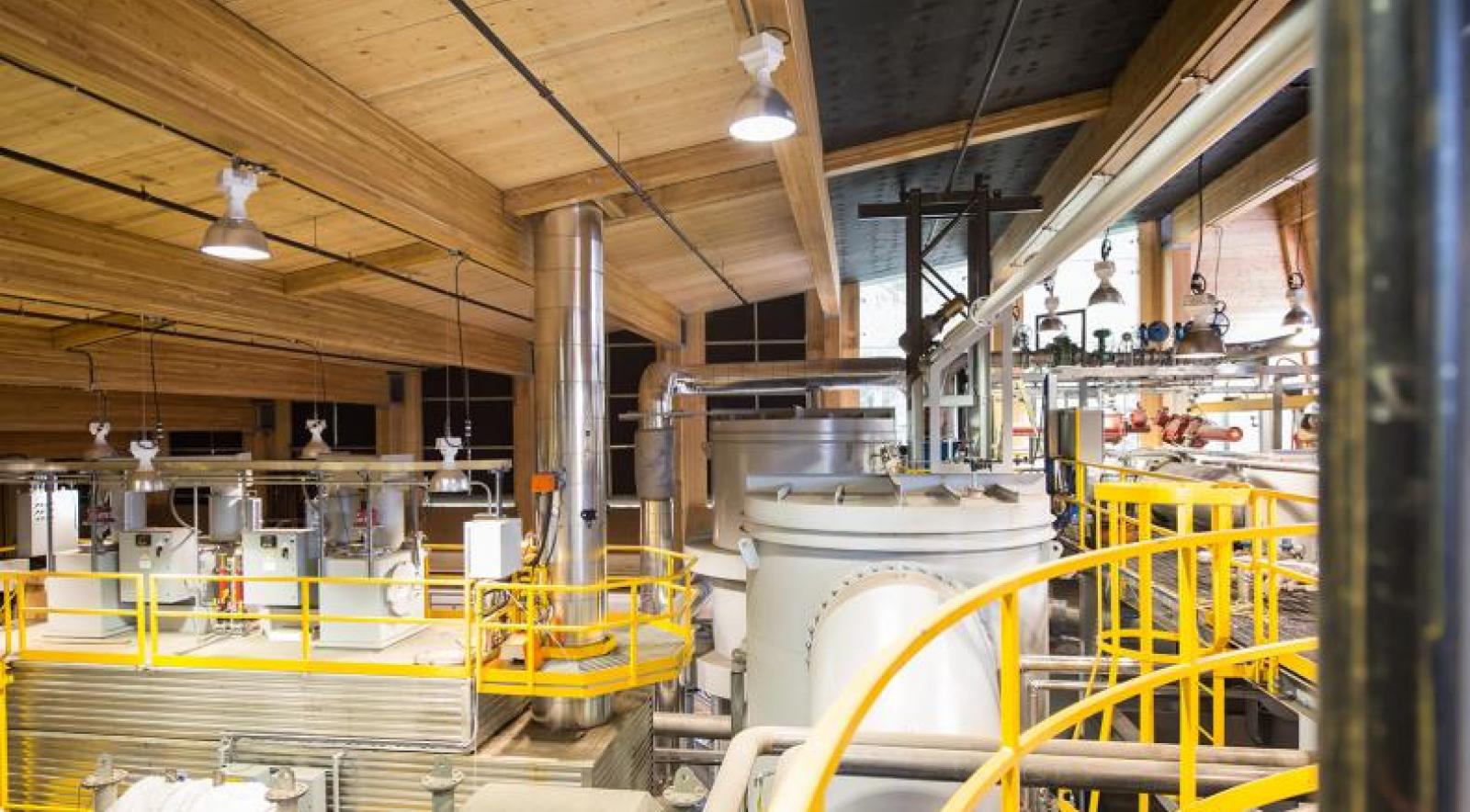
The Nexterra/GE CHP system has a number of primary components. Biomass fuel is fed into Nexterra proprietary gasification technology where it is converted into synthetic gas or “syngas”. The syngas is then cleaned and conditioned in Nexterra’s proprietary syngas conditioning technology so that all impurities are removed and it meets the fuel specifications of the gas engine. The clean syngas is directly injected into a GE high efficiency gas engine, which produces electricity and heat. The electricity will be fed into UBC’s on-campus grid and the heat used to produce steam. The steam will be fed into UBC’s on-campus system for heating the classrooms and other buildings on campus. The Nexterra/GE CHP system is highly automated and will be fully integrated with UBC’s powerhouse.
At the core of the Nexterra/GE CHP System is Nexterra proprietary biomass gasification technology. Gasification is a thermo-chemical process that uses heat to convert any carbon-containing fuel into a clean burning gas, commonly referred to as “syngas”. Gasification differs from combustion because it uses just 30% of the air or oxygen needed for complete fuel combustion. During gasification, the amount of air supplied to the gasifier is carefully controlled so that only a small portion of the fuel burns completely. This “starved air” combustion process provides sufficient heat to chemically break down the balance of the fuel into syngas that can be distributed to a variety of energy users. Syngas is a low-heating value clean burning gaseous fuel that can be used as a substitute for natural gas, fuel oil or propane to produce process heat, steam, hot water and/or electricity using conventional energy recovery equipment. Syngas is composed primarily of carbon monoxide, hydrogen and methane and has a heating value that is approximately 10 – 15% that of natural gas.
In addition to the gasification technology, the Nexterra/GE CHP System employs Nexterra proprietary gas cleaning/conditioning technology to clean and refine the biomass-derived syngas so that it can be directly fired into the GE engine to generate electricity. Nexterra recently announced the successful completion of performance testing of its proprietary gas conditioning technology. The Nexterra syngas conditioning technology is based on a closed-loop, thermal cracking and heat recovery process, which is designed to be simpler, cleaner, more reliable and lower cost than competing gas clean-up systems. Nexterra initiated development of the technology in 2007. Proof-of-concept testing was completed in 2008. Pilot and performance testing commenced in 2009.
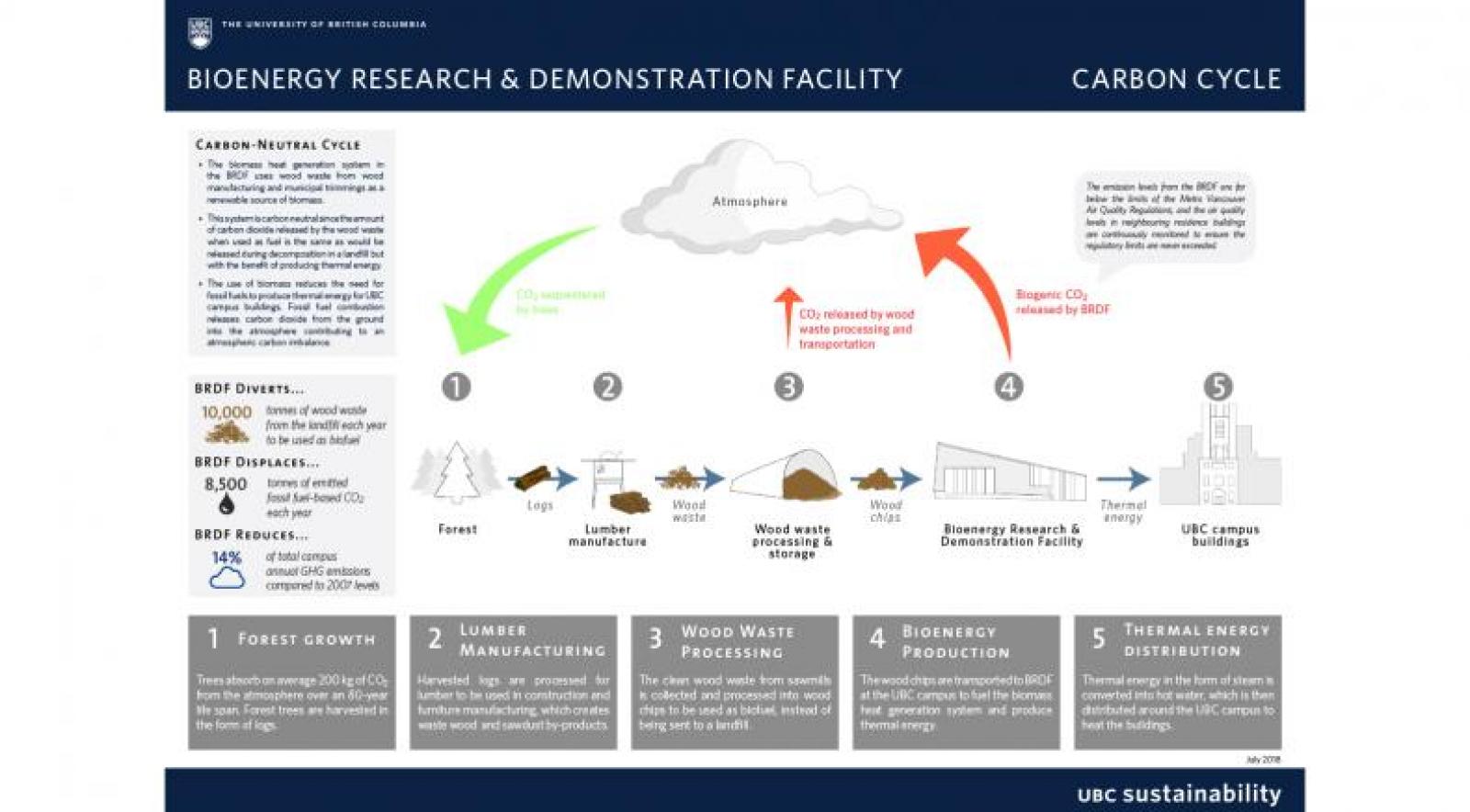
Biomass refers to renewable organic matter, such as wood or wood waste and organic components of municipal and industrial wastes. It originates from renewable biomatter, such as plants and trees, which can be naturally replenished continuously and indefinitely through responsible forestry and agricultural practices. Biomass plays an important role in the natural carbon cycle since plants and trees absorb carbon dioxide as they grow, and then naturally release it into the atmosphere, along with other gases, when they die and decay, or burn. Biomass is considered to be a carbon neutral fuel. Therefore, when biomass or syngas derived from biomass is used to displace fossil fuels it reduces greenhouse gas emissions.
Biomass-produced renewable energy is emerging as a critical element in solutions focused on increasing the availability of renewable energy and achieving meaningful and timely reductions of greenhouse gas emissions. A key reason for the emerging prominence of biomass is that biomass energy is the only source of renewable energy that is widely available, constant, and load following. It is also increasingly viewed as being the one of the most cost-effective sources of renewable energy. U.S. Dept. of Energy data indicates that biomass currently provides slightly more than 3 percent of all energy consumed in the U.S. and 48 percent of all renewable energy. The US Energy Information Agency projects that electricity generated from biomass will grow more rapidly that other renewables moving forward.